Photofeeler Alternative: Human Votes vs Instant AI Photo Feedback
A practical, neutral guide to choosing the right feedback method for dating, professional, and social profile pictures
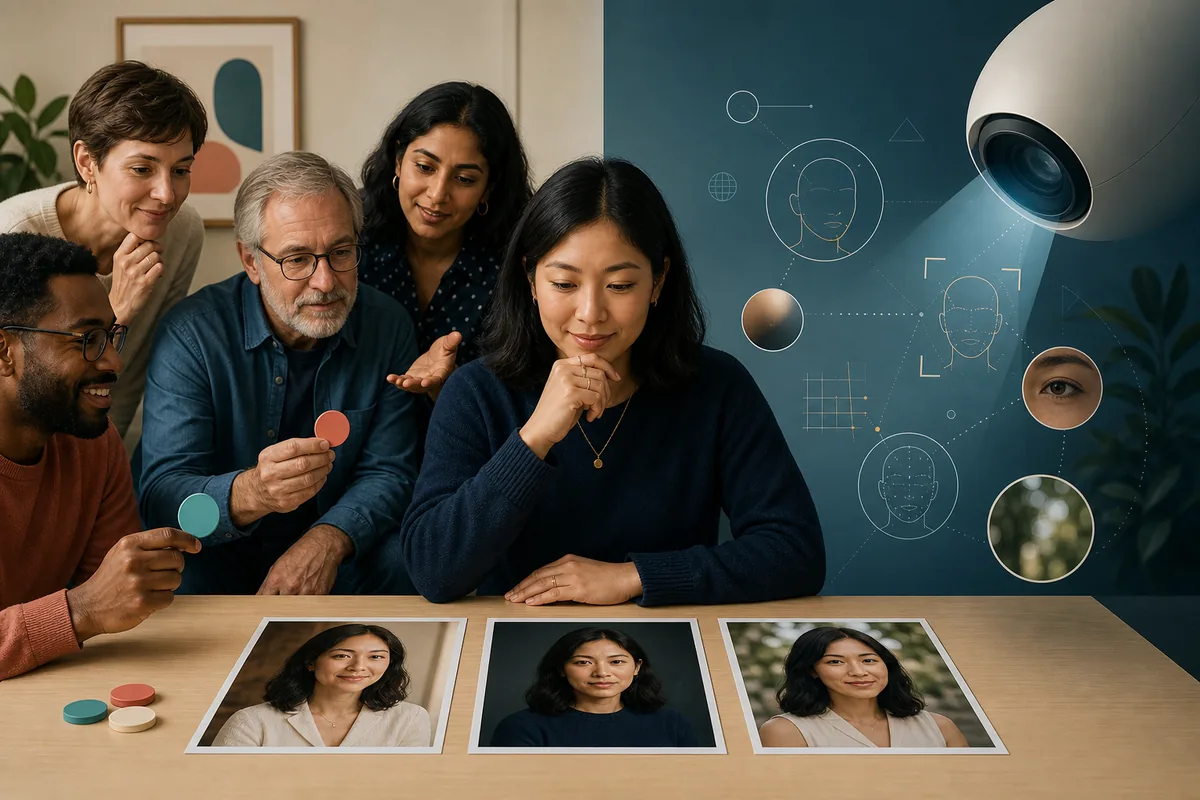
Searching for a Photofeeler alternative usually means you have a specific problem: you cannot tell which profile picture creates the strongest first impression. Photofeeler collects ratings from real people, while newer AI photo raters return feedback within seconds. Friends, public communities, and professional reviewers offer still other kinds of evidence.
These options are not interchangeable. A crowd can tell you how a selected audience reacts, but it may take time to gather enough votes. AI can consistently flag lighting, crop, expression, face visibility, and background distractions, but it cannot reproduce the preferences of your actual dating matches, recruiters, or clients. An expert can interpret the whole profile, though that depth usually costs more.
This guide compares the methods by speed, feedback source, privacy, repeatability, and best use case. It does not claim that one score can measure your real attractiveness or professional value. The goal is narrower and more useful: choose a photo that communicates clearly in the context where you will use it.
Quick Verdict: What Is the Best Photofeeler Alternative?
For fast photo-by-photo iteration, an AI profile picture rater is the most practical alternative. You can test several versions in one sitting and look for repeated comments about lighting, framing, expression, sharpness, and background. RateMyPhoto's profile picture rater fits this job because it returns a structured score and improvement notes without waiting for a voting pool.
For a genuine audience-reaction question—such as whether a dating photo feels approachable or a headshot looks trustworthy—human votes remain valuable. Photofeeler and community-based alternatives measure perception rather than technical image quality. If you need feedback on prompts, bio, photo order, and overall positioning, use a full-profile reviewer instead of testing one image in isolation.
Choose by question, not by brand
Ask what you need to learn. Use AI for quick diagnosis and repeatable comparisons; use human feedback for audience perception; use an expert for a complete profile strategy.
Photofeeler vs AI Photo Raters, Friends, Communities, and Experts
A useful comparison separates the source of feedback from the speed of delivery. The table shows what each method can reasonably tell you and where it becomes unreliable.
| Method | Feedback source | Speed | Best for | Main limitation |
|---|---|---|---|---|
| Photofeeler | Standardized human votes | Depends on votes or credits | Audience first impressions | Requires a meaningful sample and still reflects the selected voters |
| AI photo rater | Model-based image analysis | Seconds | Fast iteration and photo-quality diagnosis | Cannot reproduce a real target audience |
| Friends or peers | People who know you | Minutes to days | Authenticity and context | Courtesy bias and inconsistent questions |
| Public community | Open forum participants | Variable | Broad qualitative comments | Privacy, moderation, and reviewer fit |
| Professional reviewer | Named specialist | Hours to days | Full-profile strategy | Higher cost and reviewer-dependent judgment |
Photofeeler's official explanation says its scores are standardized against the voting behavior of each reviewer. That makes the result more sophisticated than a raw average, but it is still a perception sample. A strong result means the tested audience reacted well to that particular photo; it does not prove that the same photo will perform identically on every platform or in every market.
An AI photo rater is more repeatable because the same system applies similar criteria each time. That consistency is useful when comparing two crops or two lighting setups. It can also become a limitation: a model may favor patterns in its training data, miss cultural context, or sound more certain than the evidence allows. Treat the output as a photo-quality estimate, not a verdict on the person.
Friends know your personality and may notice whether a picture feels authentic. They are also motivated to be kind, and different friends may imagine different audiences. Public forums can provide blunt feedback, but the reviewer population, moderation quality, and privacy risk are hard to control. Paid experts are most useful when they explain trade-offs and connect individual photos to the full profile story.
Which Photo Feedback Method Fits Your Goal?
Choose instant AI feedback
Best when you have several candidate photos and want quick, consistent notes on crop, lighting, expression, clarity, and background. It is efficient for narrowing ten images to a shortlist of three.
Choose human voting
Best when the core question is how strangers in a target context perceive one or two finalists. Give the test enough responses and compare confidence or consistency, not only the headline number.
Ask a small trusted group
Best when authenticity matters and reviewers understand your real personality or professional role. Ask specific questions so the conversation does not collapse into polite reassurance.
Hire a profile reviewer
Best when photo order, prompts, bio, positioning, and audience strategy all need attention. A review should explain why each recommendation fits the intended platform and goal.
How to Test Profile Photos Without Chasing Random Scores
The common mistake is uploading unrelated photos and treating the highest number as truth. A better process controls the input, tests one decision at a time, and combines different evidence only when it answers a useful question.
Start with photographs that are suitable for the same role. A close professional headshot and a full-body hiking photo may both be good, but they perform different jobs. Compare possible main photos against other possible main photos; compare social proof images against other social images.
- Define the use case. Write down the platform and job of the image: dating lead photo, LinkedIn headshot, creator avatar, or casual social profile.
- Create a clean shortlist. Remove blurry images, heavy filters, group photos where you are hard to identify, and crops that hide the face at thumbnail size.
- Run an AI diagnostic. Use the same tool for every candidate and record recurring notes. Repeated issues are more informative than a one-off decimal score.
- Change one variable. Test a tighter crop, softer front light, a cleaner background, or a more relaxed expression without changing everything at once.
- Validate the finalists with people. Ask a target-relevant group which photo feels most approachable, competent, authentic, or memorable. Match the question to the platform.
- Review real outcomes. After using the image, watch profile views, replies, quality conversations, or recruiter response. Platform results matter more than any isolated rating.

What No Photofeeler Alternative Can Tell You Reliably
A photo test observes an image, not your full character, attractiveness in motion, competence, warmth, or compatibility. Even human reviewers see a controlled frame with limited context. Scores can shift when the crop, screen size, reviewer mix, platform, or surrounding profile changes.
Do not keep testing until a random high score confirms what you want to hear. Look for stable patterns across several photos and methods. A technically perfect image can feel generic, while a slightly imperfect photograph can be memorable and authentic. The best choice is often the clearest image that still feels like you.
- AI feedback can reflect training-data bias and may overvalue familiar visual patterns.
- Crowd ratings depend on who votes, how many people respond, and how the question is framed.
- Friends may be supportive rather than diagnostic, especially when the question is vague.
- A high attractiveness score does not guarantee dating matches, job opportunities, or social engagement.
- Repeated testing can become unhelpful if it increases self-criticism instead of improving a concrete photo decision.
Privacy Checks Before Uploading a Face Photo
A face photo is sensitive personal data. Before using Photofeeler, an AI photo rater, a forum, or another alternative, check whether the image becomes public, how long it is stored, whether it is used for model training, and whether you can delete it. Community voting may expose the image to more people by design; AI processing may involve third-party infrastructure even when there is no public gallery.
Upload only photographs you have the right to use. Do not test a partner, friend, coworker, or stranger without permission. Remove location clues, work badges, children, documents, and private background details when they are irrelevant to the feedback you need.
Frequently Asked Questions
Bottom Line: Build a Feedback Stack
The strongest Photofeeler alternative may be a two-stage process rather than one replacement. Use instant AI feedback to remove weak candidates and improve controllable details. Then use a small human test to learn how the finalists land with the audience that matters. Escalate to an expert only when the problem includes the complete profile or positioning strategy.
Keep the result in perspective. You are choosing a communication asset, not measuring personal worth. The most useful feedback tells you what to change, why it matters, and whether the next version actually works better.
Continue with the dating profile picture guide, the best profile picture guide, and how AI rates your photo.