Facial Thirds: How to Measure and Understand Face Proportions
A practical, evidence-aware guide to the upper, middle, and lower thirds of the face—and what a photo can change.

Quick answer
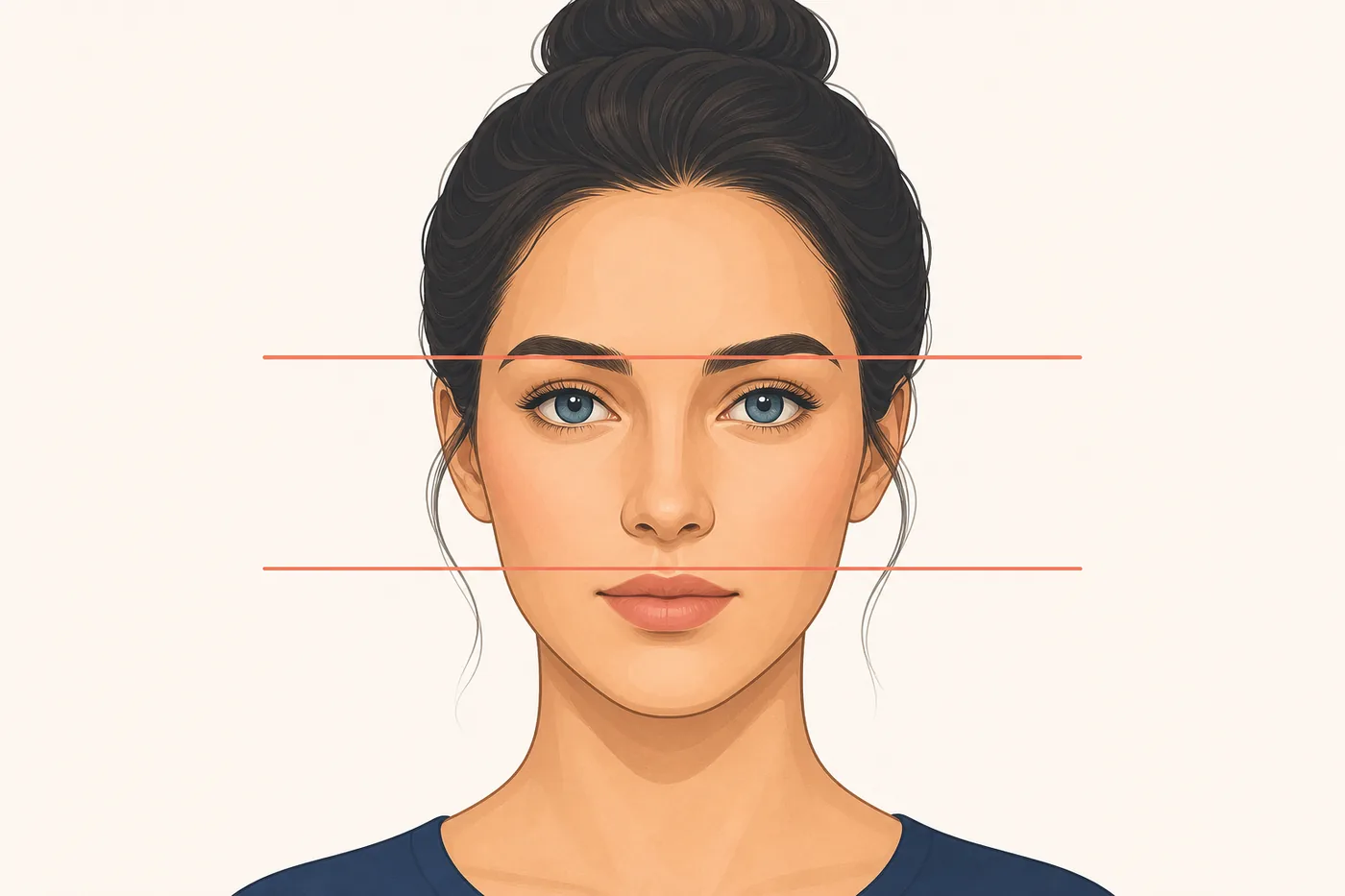
Facial thirds divide a front-facing face into three vertical regions: hairline to brow line, brow line to the base of the nose, and base of the nose to the bottom of the chin. Similar lengths can look balanced, but exact 1:1:1 proportions are not a universal beauty standard. Hairline shape, age, expression, camera distance, head tilt, and individual anatomy all affect the result.
Table of Contents
Facial thirds are a simple way to describe vertical face proportions. Artists, photographers, orthodontic clinicians, and facial-analysis writers use the framework because it turns a complex face into three landmarks that are easy to compare.
The framework is useful for understanding a portrait, but it should not be used as a diagnosis or a score of a person's worth. Research on facial canons shows substantial variation across populations and individuals, so a measured difference is usually descriptive rather than a defect.
This guide explains the facial thirds ratio, shows a repeatable photo-measurement method, separates facial thirds from facial symmetry and the golden ratio, and helps you interpret an equal or unbalanced result without overclaiming.
What Are Facial Thirds?
The three regions are traditionally called the upper, middle, and lower facial thirds. The upper third runs from the trichion—the central hairline landmark—to the brow line or glabella area. The middle third runs from the brow line to the subnasale at the base of the nose. The lower third runs from the subnasale to the menton at the lowest point of the chin.
When the three distances are close, people may describe the face as having equal facial thirds. When one region is visibly longer or shorter, the face has an unbalanced facial-thirds pattern. That wording describes proportion only; it does not prove attractiveness, health, or a need for treatment.
Upper third
Hairline to brow line. This is the least stable region because hairstyles, hair loss, and hairline shape change the landmark.
Middle third
Brow line to the base of the nose. Head pitch and camera angle can make this region appear shorter or longer.
Lower third
Base of the nose to the bottom of the chin. Expression, lip position, jaw posture, and lens perspective influence its appearance.
How to Measure Facial Thirds From a Photo
Use the method as a comparison exercise, not a clinical measurement. A neutral, level photograph matters more than pixel-perfect lines.
- 1. Choose a suitable photo. Use a straight-on portrait with the whole hairline and chin visible. Avoid beauty filters, portrait warping, strong perspective, and a tilted head.
- 2. Increase camera distance. A phone held close can enlarge the center of the face. Step back and use a moderate zoom or crop afterward.
- 3. Mark four landmarks. Identify the central hairline, brow or glabella line, base of the nose, and lowest point of the chin.
- 4. Draw three vertical intervals. Measure hairline-to-brow, brow-to-nose-base, and nose-base-to-chin along the same center line.
- 5. Convert lengths into a ratio. Divide every distance by the shortest one. A result such as 1.08:1.00:1.12 is easier to compare than raw pixels.
- 6. Repeat on another photo. If the ratio changes greatly, the first result was probably affected by pose, crop, expression, or camera perspective.
Facial Thirds Landmarks and Common Errors
Small landmark choices can produce large differences. Use the same definition every time.
| Region | Landmarks | Common measurement error |
|---|---|---|
| Upper | Central hairline to brow/glabella line | Using the top of the hairstyle instead of the actual hairline |
| Middle | Brow/glabella line to subnasale | Measuring to the nose tip rather than the base of the nose |
| Lower | Subnasale to bottom of chin | Measuring while smiling, opening the mouth, or tucking the chin |
If the hairline is hidden or irregular, do not invent a precise upper-third value. Record it as uncertain and focus on the visible middle and lower proportions.
How to Interpret Equal or Unbalanced Facial Thirds
A ratio near 1:1:1 can create a familiar sense of vertical balance, but natural faces rarely match a perfect template. A slightly longer lower third, shorter upper third, or longer middle third can still look harmonious because width, feature spacing, cheek structure, expression, and hairstyle change the overall impression.
Facial harmony is broader than facial thirds. Harmony describes how many features work together; facial thirds describe only three vertical distances. Facial symmetry compares left and right sides, while the golden ratio uses other proportional relationships. These ideas overlap, but they are not interchangeable.
Treat a large difference as a prompt to check the photo setup first. If the same pattern appears in multiple neutral photos and you are simply choosing a profile picture, use styling, crop, lighting, and camera height rather than trying to force a geometric ideal.
- Use a range, not a pass/fail cutoff.
- Compare multiple neutral photos before drawing a conclusion.
- Do not infer personality, health, or attractiveness from one ratio.
- Remember that population averages do not define an ideal individual face.
- Seek a qualified clinician only for a real functional or medical concern—not for a casual photo measurement.
Why Facial Thirds Change Between Photos
A face does not physically change between two quick photos, but its projected proportions can. Perspective, head pitch, lens position, cropping, and expression alter where the landmarks appear in a flat image.
For useful comparisons, keep the camera farther away, near eye level, and centered. Use soft frontal light so shadows do not hide the hairline, brow, nose base, or chin.
| Photo variable | What it can do | Better setup |
|---|---|---|
| Camera too close | Enlarges central features and can compress outer proportions | Step back and crop later |
| Camera above eye level | Can shorten the lower third | Start near eye height |
| Camera below eye level | Can emphasize the chin and lower third | Level the lens with the face |
| Head tilted up or down | Moves the nose and chin landmarks vertically | Keep eyes and ears approximately level |
| Strong smile | Changes lip position and lower-face height | Use a relaxed, closed-mouth expression for measurement |
Limits: Facial Thirds Are Not a Beauty Score
Classical facial canons were developed as simplified references, not universal biological laws. Studies comparing measured faces with traditional canons repeatedly find meaningful variation by population, sex, age, and method.
A photo measurement is also less reliable than a standardized clinical image. Hairline ambiguity, facial hair, makeup, lens correction, and image editing can shift landmarks. Avoid turning a rough proportion into a medical claim or a promise that changing one region will improve attractiveness.
Use the framework responsibly
Facial thirds can help explain composition and camera effects. They cannot determine whether someone is attractive, healthy, or suited for a procedure.
Use Facial Thirds to Improve a Portrait—not Judge a Face
If a portrait feels vertically unbalanced, first test reversible photography changes: move the camera back, level it, show the true hairline, relax the mouth, and compare a slightly higher or lower crop. A hairstyle or framing choice can also change perceived balance without changing the face.
After correcting the setup, compare the full photo rather than chasing a perfect ratio. Clarity, expression, lighting, grooming, and context usually matter more to a profile picture than a small difference between facial thirds.
Compare your portrait presentationFrequently Asked Questions
What does facial thirds mean?
Facial thirds divide vertical face height into upper, middle, and lower regions using the hairline, brow line, base of the nose, and chin as landmarks.
What is the ideal facial thirds ratio?
The traditional reference is approximately 1:1:1, but it is not a universal ideal. Natural and attractive faces show substantial variation.
How important are facial thirds for a face?
They are one useful description of vertical proportion. Expression, feature spacing, width, symmetry, hairstyle, lighting, and camera perspective also shape the overall impression.
Can facial thirds be measured from a selfie?
Yes, roughly, but a close selfie can distort proportions. Use more camera distance, a level head, neutral expression, and more than one photo.
Are facial thirds the same as the golden ratio?
No. Facial thirds compare three vertical regions. Golden-ratio analyses use different distances and mathematical relationships.
Can facial thirds change?
Actual skeletal and soft-tissue proportions change gradually with growth and aging, while photo-based thirds can appear to change immediately because of pose, lens distance, crop, hairline, or expression.
Do unbalanced facial thirds mean a face is unattractive?
No. A non-equal ratio is common and cannot determine attractiveness. Overall harmony and photo quality depend on many interacting features.
References and further reading
The practical takeaway
Facial thirds are a descriptive map: hairline to brow, brow to nose base, and nose base to chin. Measure them only in a neutral, low-distortion photo, use ratios as ranges, and interpret differences in the context of the whole face. Equal thirds may look balanced, but perfect equality is neither common nor required.