How Old Do I Look? AI Age Guesser Guide for Better Photo-Based Age Checks
A practical guide to how old do I look tools, AI age estimation accuracy, privacy checks, and the photo choices that change your result

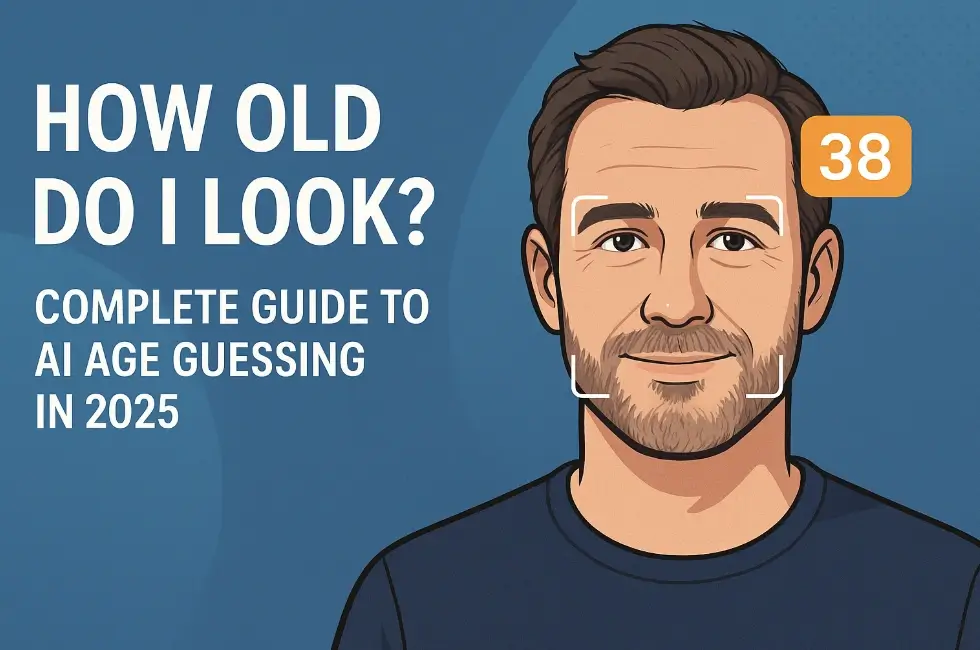
Table of Contents
If you have ever asked, "How old do I look?" an AI age guesser can give you a fast answer, but that answer only makes sense when you understand what the model is actually measuring. Most tools estimate apparent age from visible facial cues and photo quality, not your biological age or overall health. That distinction matters. The same person can look years younger in soft front light and several years older in a noisy, low-resolution selfie with harsh shadows. This guide explains how AI age guesser tools work, why age predictions change from one image to another, what privacy checks you should make before uploading a face photo, and how to use these tools for better profile, selfie, and portrait decisions.
What Is an AI Age Guesser?
An AI age guesser is a machine learning tool that analyzes a face photo and predicts how old the person appears. The result may be shown as an exact age, an age range, or a confidence-backed estimate.
Most how old do I look tools examine a mix of facial structure, skin detail, and presentation signals such as:
- Skin texture and visible lines - Fine lines, pores, contrast, and smoothness can push apparent age up or down.
- Eye-area signals - Under-eye shadows, crow's feet, eyelid shape, and puffiness often influence age estimation.
- Face shape and volume - Jawline definition, cheek volume, and facial fullness can change perceived age.
- Expression and tension - A relaxed smile often reads younger than a tense or tired expression.
- Image quality - Blur, compression, and bad lighting reduce what the AI can read and often produce less stable results.
Did You Know?
Peer-reviewed age estimation research shows that modern models can be directionally useful on clear portrait images, but prediction quality drops when lighting, angle, or occlusion reduce facial detail. Nature Scientific Reports.
How AI Estimates Age From a Photo
A typical how old do I look tool follows a sequence that is simpler than it looks from the outside.
1. Face detection
The model first locates the face. If the face is too small, covered, or turned too far away, the prediction becomes less reliable.
2. Landmark mapping
The AI marks key points around the eyes, nose, mouth, jawline, brows, and face outline to measure structure and proportion.
3. Feature extraction
It extracts patterns linked to apparent age, such as skin texture, facial volume, eye-area detail, and face shape.
4. Model prediction
Those features are compared against training data containing faces with known ages or human-perceived age labels to estimate apparent age.
5. Confidence adjustment
Better tools temper the final output based on image quality and prediction certainty instead of pretending every guess is equally strong.
95%
Directionally useful on clear headshots
<3s
Typical prediction time
100+
Signals and landmarks analyzed
When Age Guesser Results Are Useful
The best use of an AI age guesser is comparison, not self-judgment. If you compare multiple portraits, you can often see which lighting setup, angle, or expression makes you look more rested, younger, or more polished.
| Use case | What the result helps with | Best practice | Risk to avoid | |
|---|---|---|---|---|
| Profile photo selection | Compare which headshot looks fresher and clearer | Test 3 to 5 photos with similar framing | Treating one low score as a verdict | |
| Dating app photos | Find the photo that looks warm, sharp, and approachable | Use natural light and eye-level framing | Uploading filtered or shadow-heavy selfies | |
| Professional portraits | See which image looks most rested and polished | Use neutral backgrounds and even light | Over-prioritizing youth over professionalism | |
| Curiosity and learning | Understand how AI reacts to visual age cues | Compare patterns rather than one number | Confusing apparent age with health or worth |
Why Results Change Between Photos
If two photos of the same person get different age estimates, that does not mean the AI is broken. It usually means the tool is responding to differences in visible age cues and image quality.
Photo quality factors
- Lighting - Overhead or side-heavy light can exaggerate lines, shadows, and under-eye texture.
- Resolution - Low-resolution or compressed images remove the detail the model uses to estimate age.
- Angle - Extreme angles distort the face and hide age-related cues around the eyes, cheeks, and jawline.
- Distance from camera - Too close can introduce lens distortion; too far removes facial detail.
Personal and styling factors
- Sleep and stress - Tired eyes and facial tension can make the same person appear older.
- Makeup and grooming - Grooming, skincare, and light makeup can change apparent age in photos.
- Expression - A natural smile often reads younger than a flat or tense look.
- Styling choices - Hair, glasses, clothing color, and background all affect presentation.
Important Note
AI age guessers estimate how old you look in one image. They do not diagnose health, predict biological age precisely, or tell you how old you look in person across all contexts.
Photo Quality Impact on Accuracy
| Factor | Impact on Accuracy | Recommendation |
|---|---|---|
| Lighting | High | Use soft front-facing daylight or even indoor light |
| Resolution | Medium | Prefer clear, high-resolution photos |
| Face angle | High | Stay near frontal, within a slight turn |
| Distance | Medium | Keep the face large enough to read without distortion |
| Expression | Medium | Use a relaxed natural expression |
| Heavy filters | High | Avoid beauty filters that create unnatural texture |
How to Get a More Accurate or Younger-Looking Result
If you want a more useful how old do I look result, improve the photo before you blame the model.
Photo setup choices that help
- Use soft front light - Natural daylight from a window is one of the easiest ways to reduce age-adding shadows.
- Keep the camera at eye level - Eye-level framing usually produces a more balanced and realistic age estimate.
- Use a clean background - A simple background keeps the face as the primary subject.
- Choose a sharp image - A clear, focused image gives the AI more stable data to work with.
Presentation choices that often read younger
- Relax your expression - A gentle smile and relaxed eyes often reduce perceived age.
- Reduce harsh shadows - Avoid top-down lighting that exaggerates eye bags and lines.
- Avoid extreme close selfies - Moderate camera distance reduces distortion around the nose and jaw.
- Test several photos - Compare three to five images before deciding which result is most representative.
Privacy and Safety Checks Before Uploading
A face photo is sensitive data. Before you upload one to any age guesser site, check how the service treats storage, training, and deletion.
What to check
- Storage policy - Look for a clear statement about whether images are deleted immediately or retained.
- Training use - Check whether uploaded photos may be used to improve the model.
- Account requirements - Prefer tools that do not require unnecessary sign-up for a simple age check.
- Encryption - Use only pages served over HTTPS.
- Deletion rights - If photos are stored, confirm whether deletion or export rights exist.
Privacy Note
Use age guesser tools carefully and avoid services that promise privacy without explaining storage, training use, or deletion behavior. Read the Privacy Policy.
Why context matters
Age estimation systems can reflect dataset bias, beauty bias, and demographic imbalance. Results should be treated as rough photo feedback, not as a personal judgment or a basis for decisions about someone else.
- Dataset bias - Some models perform better on the face types and age ranges they saw more often during training.
- Apparent age vs. real age - Looking older or younger in a photo does not reveal health or character.
- Misuse risk - Age estimates should not be used to shame, profile, or exclude people.
Where AI Age Estimation Is Headed
Age estimation models are improving, but the next step is not only raw accuracy. Better tools will be more transparent about confidence, privacy, and failure cases.
What better tools should do
- Show confidence, not fake certainty - A weak image should produce a cautious estimate, not a misleading exact number.
- Separate image quality from age cues - Users should be able to see whether the result changed because of lighting or because of the face itself.
- Improve fairness across groups - Broader training coverage can reduce demographic bias in age estimates.
Likely practical uses
Outside consumer curiosity, age estimation may remain useful in product testing, portrait QA, and some verification workflows, but only with strong privacy and bias controls.
- Portrait optimization - Comparing which headshot looks younger, clearer, or more energetic.
- Creative tools - Helping users choose flattering selfies and thumbnails.
- Research and QA - Studying apparent-age shifts across lighting, camera, or styling changes.
The strongest future differentiator will not be the flashiest number. It will be whether the tool explains what changed, protects uploads, and respects the limits of photo-based age prediction. Grand View Research.
Bottom Line
A how old do I look tool is most useful when you treat it as structured photo feedback. It can help you see which portrait looks younger, clearer, or more polished, but it cannot define your real age, value, or attractiveness.
Use AI age guesser results to improve lighting, framing, and expression. Compare multiple photos, watch for patterns, and ignore the temptation to overread a single estimate.
If you want the best result, change the photo before you change your opinion of yourself.
Frequently Asked Questions
About the Author
Emily Chen
Emily Chen writes about practical AI products, facial analysis systems, and the tradeoffs behind consumer image tools. Her reviews focus on how people can use AI photo feedback without overreading one score or one prediction.
References and Further Reading
Last updated: June 5, 2026