AI Attractiveness Test Guide: How AI Rates Your Face and What the Score Really Means
A practical guide to face attractiveness scores, photo quality, accuracy limits, bias, privacy, and safer ways to use AI beauty feedback

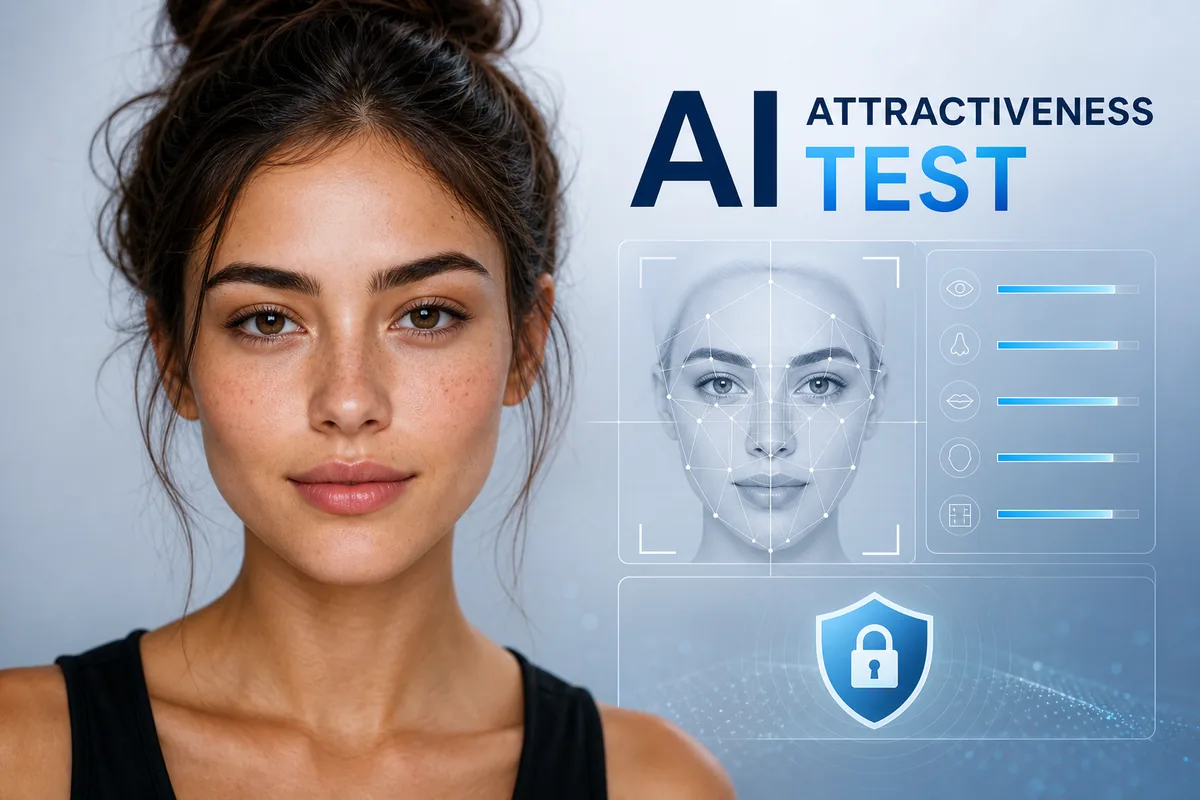
Table of Contents
- What Is an AI Attractiveness Test?
- How AI Attractiveness Ratings Are Calculated
- What an AI Beauty Score Can and Cannot Tell You
- Why Your Score Changes Between Photos
- Are AI Attractiveness Tests Accurate?
- Bias, Culture, and Objective Beauty
- Is It Safe to Upload a Face Photo?
- How to Get a More Useful Result
- FAQ
An AI attractiveness test can be useful, but only if you understand what it is actually measuring. The score is not a universal beauty ranking. It is a photo-based estimate built from visible facial patterns, image quality, and training data that reflects how people have rated faces in the past.
That distinction matters. A frontal portrait in soft daylight may receive a high attractiveness rating by AI, while the same person in dim lighting, with blur, harsh shadows, or a wide-angle selfie distortion may receive a much lower score. The tool is reacting to the image in front of it.
This guide explains how a face attractiveness test usually works, what an AI beauty score can and cannot tell you, why the result changes between photos, and what privacy checks to make before uploading your face.
What Is an AI Attractiveness Test?
An AI attractiveness test is a tool that analyzes a face photo and returns a score, usually on a 1-10 scale, a percentage scale, or a grade. Most tools position the result as an attractiveness rating, beauty score, face rating, or face attractiveness score.
Under the hood, these tools do not see beauty the way a person does. They detect a face, locate landmarks such as the eyes, nose, mouth, jawline, and face outline, then compare visible patterns against data learned from previously rated images.
A good AI face rating should be treated as structured photo feedback. It can suggest whether your portrait is clear, balanced, well lit, and aligned with common rating patterns. It cannot measure charisma, confidence, voice, humor, warmth, personal style, or real-world chemistry.
Short Answer
An AI attractiveness test estimates how one photo aligns with statistical face and photo-quality patterns. It does not define your real attractiveness or personal value.
How AI Attractiveness Ratings Are Usually Calculated
Different tools use different models, but most modern AI for attractiveness follows a similar pipeline.
1. Face detection
The system first finds the face in the image. If the face is too small, turned too far away, covered by sunglasses, or hidden by shadows, the model has less reliable information.
2. Landmark mapping
The AI identifies facial landmarks such as eye corners, eyebrow edges, the nose tip, mouth corners, chin, cheek contours, and the face outline. These points allow the model to calculate symmetry and proportions.
3. Geometry and proportion checks
Many systems estimate left-right symmetry, face width-to-height ratio, eye spacing, facial thirds, jawline shape, and overall facial harmony. Some tools explain this using golden-ratio language, although that should be treated as one rough framework rather than a universal rule.
4. Photo quality analysis
The model also reacts to lighting, blur, resolution, expression, camera angle, lens distortion, and background complexity. These factors can change the score even when the same person is in every photo.
5. Model scoring
Finally, the features are passed into a model trained to predict how humans might rate the image. The result is converted into an attractiveness score, a beauty score, or a set of sub-scores.
What an AI Beauty Score Can and Cannot Tell You
The biggest mistake is reading one number too literally. A score can be a useful signal, but it is narrow. The table below is a safer way to interpret the output.
| Signal | What AI Can Estimate | What It Cannot Prove |
|---|---|---|
| Facial symmetry | Landmark balance between left and right sides | That symmetry equals real-world attractiveness |
| Facial proportions | Distances between eyes, nose, mouth, jaw, and face outline | That one proportion system fits every culture or person |
| Skin visibility | Texture, clarity, contrast, and lighting quality | Health, age, lifestyle, or true skin condition |
| Expression | Smile, neutral expression, eye openness, and face tension | Personality, warmth, humor, or confidence in motion |
| Photo quality | Sharpness, exposure, blur, angle, and composition | How attractive someone is in person |
Practical Interpretation
If your score is lower than expected, first test a better photo before assuming the result says anything meaningful about your face.
Why Your Score Changes Between Photos
It is normal for the same person to receive different results from different pictures. The AI is not only rating facial structure; it is rating what the camera made visible.
A close phone selfie can widen the nose and narrow the face because of lens distortion. Overhead light can create under-eye shadows. A side angle can hide symmetry cues. A smile can lift the cheeks and change the eyes. Compression can remove skin texture and edge detail. All of these inputs can move the final attractiveness rating.
| Factor | Why It Changes the Score | Better Input |
|---|---|---|
| Lighting | Harsh shadows distort facial contours and skin texture | Soft front light |
| Camera angle | Side angles hide landmarks and change proportions | Eye-level frontal photo |
| Lens distance | Close selfies can widen central features | Moderate camera distance |
| Expression | Smile and facial tension change cheeks, eyes, and jawline | Relaxed natural expression |
| Resolution | Blur makes landmarks and texture harder to read | Clear high-resolution image |
| Obstructions | Sunglasses, hats, hands, or hair hide key landmarks | Uncovered full face |
For that reason, the best use case is comparison. Upload three to five photos, look for the highest and most consistent score, and study what those better photos have in common. The winning pattern often involves soft front light, eye-level framing, a relaxed expression, and a clean background.
Are AI Attractiveness Tests Accurate?
AI attractiveness tests are more accurate at measuring visible image patterns than they are at measuring real human appeal. They can be consistent when the photo is clear, frontal, and well lit. They are less reliable when the face is angled, obscured, heavily filtered, or photographed in poor light.
Research on facial attractiveness often discusses symmetry, averageness, skin texture, facial proportions, and related visual cues. Facial beauty prediction datasets such as SCUT-FBP and SCUT-FBP5500 show that machine learning can learn patterns from human attractiveness ratings. However, learning rating patterns is not the same as discovering an objective standard of beauty.
A fair conclusion is this: AI face rating is useful for photo feedback, rough comparison, and curiosity. It should not be used for medical, psychological, hiring, dating-worth, or self-worth judgments.
Bias, Culture, and the Limits of Objective Beauty
No AI attractiveness test is culturally neutral by default. The model learns from training data, and training data reflects the people, labels, regions, age groups, skin tones, camera styles, and beauty preferences included in it.
If a dataset overrepresents one region or aesthetic standard, the score can overvalue that pattern. This is why claims such as fully objective beauty score or universal attractiveness rating should be treated carefully.
A better tool should explain its limits, avoid insulting language, and frame the result as a photo analysis rather than a personal judgment. A better user should treat the score as one imperfect signal, not a final answer.
Is It Safe to Upload a Face Photo?
A face photo is sensitive personal data. Before using any AI attractiveness test, check how the service handles uploads.
Privacy Checks Before Uploading
- Does the site clearly explain whether photos are stored or deleted?
- Does it say whether uploaded images are used for AI training?
- Does the tool work without requiring account creation?
- Does the page use HTTPS?
- Is there a privacy policy with a data retention explanation?
- Can you request deletion if data is stored?
Privacy Note
On RateMyPhoto.org, the goal is to provide fast photo feedback without turning your face into a permanent profile. Avoid any tool that promises privacy but gives no details about storage, training use, or third-party sharing. Read the Privacy Policy before uploading sensitive images to any AI tool. Privacy Policy
How to Get a More Useful Result From a Face Attractiveness Test
You do not need a professional studio photo, but you do need an image that gives the AI enough clean information.
- Use soft front-facing light, ideally natural daylight from a window.
- Keep the camera at eye level or slightly above eye level.
- Use a clear, high-resolution image without blur or heavy compression.
- Face the camera directly, with only a slight turn if desired.
- Avoid sunglasses, masks, hats, hands, or hair covering key facial landmarks.
- Use a simple background so the face remains the main subject.
- Try several photos and compare patterns instead of trusting one score.
Best Use Cases for AI Face Rating
The safest uses are practical and photo-focused.
Dating profile photos
Compare several portraits and choose the one with stronger lighting, clearer expression, and better framing. Do not use the score as a judgment of dating value.
Social media profile pictures
Use the score to identify which photo looks clearer and more balanced at small thumbnail sizes.
Professional headshots
Prioritize clarity, eye contact, neutral background, and approachability over chasing the highest beauty score.
Curiosity and learning
Treat the tool as a way to understand how AI sees portrait quality, symmetry, and presentation.
For a broader explanation of AI photo scoring, read how AI rates your photo
Want to rate a face directly? Try the AI face rating tool.
Bottom Line
An AI attractiveness test is best understood as a photo analysis tool. It can estimate visible patterns such as symmetry, proportions, lighting, clarity, and expression. It cannot measure the full human experience of attraction.
Use the score to choose better photos, improve lighting, and understand how presentation changes perception. Do not use it as a permanent label. The most useful result is not the number itself, but the pattern you see when you compare multiple photos.
Frequently Asked Questions
About the Author
Sophie Laurent
Sophie Laurent writes about practical AI tools, digital identity, profile photography, and online privacy. Her reviews focus on what everyday users can learn from AI systems without treating algorithmic scores as personal judgments.
References and Further Reading
Last updated: May 10, 2026